
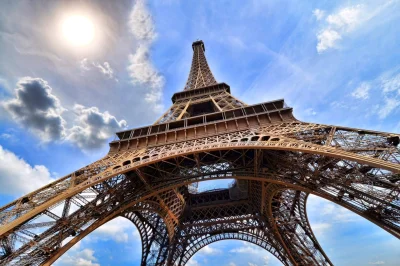
THE EIFFEL TOWER ARCHITECTURE
About Eiffel Tower
The Eiffel Tower, a popular symbol of Paris and a masterpiece of iron architecture stands tall at 330 meters. Designed by Gustave Eiffel and finalized in 1889 for the World’s Fair, it was initially met with mixed reaction but has since become one of the most recognizable landmarks in the world. The tower, with its detailed wrought iron lattice structure, presents the engineering innovation and artistic vision of its time. Providing stunning panoramic views of the City of Lights, it attracts millions of visitors each year.

Facts, height & weight
The Eiffel Tower stands at 330 meters tall and weighs approximately 10,100 tons. The iron structure itself weighs around 7,300 tons. It covers about 125 meters on each side, around 15,625 square meters.
How did it all begin
The idea for the Eiffel Tower started as a design competition for the 1889 World’s Fair celebration of the 100th anniversary of the French Revolution. French engineer Gustave Eiffel’s company submitted the winning design presenting a plan for a tall iron tower originally intended to showcase France’s engineering skills.

The architectural innovation
Design
The Eiffel Tower was a groundbreaking design for its time, made from a lightweight iron lattice that allowed it to reach impressive heights. Before the final design was chosen, 50 engineers and designers created 5,300 drawings. The original sketch, created by Maurice Koechlin and Emile Nouguier, showed a tall structure as a great pylon consisting of four iron lattices connected by horizontal beams, giving it a sleek look. Architect Stephen Sauvestre refined the design by adding decorative arches, a glass pavilion, and other ornamental details, making the tower look more elegant and less like a basic iron structure.
Construction
The Eiffel Tower was constructed between 1887 and 1889 using more than 18,000 precisely designed iron pieces prepared by 150 workers at Eiffel’s factory in Levallois-Perret. On-site, a team of 150 to 300 workers assembled these pieces, each about 5 meters in size. The tower is secured by 2.5 million rivets and weighs 7,300 tonnes. It includes five elevators, though many visitors still choose to climb the structure using Eiffel Tower Stairs Tickets. Initially, 60 tonnes of reddish-brown paint called “Venetian Red” was applied in 1889 to protect the iron from rust. Over the years, the tower’s color has changed multiple times, with its current shade, known as “Eiffel Tower Brown”, in use since 1968. It remained the world’s tallest building until the new Chrysler Building in New York City was built in 1930.

From controversy to iconic symbol
When the Eiffel Tower was built in the late 19th century, many Parisians, including prominent artists and intellectuals, strongly opposed it. They criticized the tower’s unusual, industrial design as ugly and out of place in the city’s classic architectural landscape. The public debate involved the exchange of arguments between those who saw the tower as a bold modern achievement and those who opposed this view and saw the tower as a bold modern achievement. Despite the backlash, the tower was completed in 1889 and eventually became one of the most iconic landmarks in the world.
The evolution of the Eiffel Tower’s color
As Gustave Eiffel recommended, the Eiffel Tower is repainted every seven years, using traditional hand painting methods. Its color history began with Venetian red in 1887 and has evolved to the current “Eiffel Tower Brown”, chosen to blend with Paris’s skyline. The paint is applied in three tones, darkest at the base and lightest at the top, creating a uniform look. Each repainting campaign, involving about 50 specialized painters and 60 tonnes of paint, lasts 18 months to three years, depending on weather conditions. The current color, still called “Eiffel Tower Brown”, was made a bit lighter during the 2019-2021 restoration to prepare for the 2026 Paris Olympics.

A timeless icon
Throughout history, the Eiffel Tower has served many roles beyond being a tourist attraction. During World War I, it was used by the French army as a radio tower to intercept enemy communications. In World War II, it survived Nazi occupation, with resistance fighters cutting the elevator cables to prevent easy access. The tower has been renovated multiple times to ensure safety and accommodate millions of visitors. It has also been used for scientific research, including studies on weather and aerodynamics.
Today, the Eiffel Tower stands as a global icon, representing the City of Paris and attracting millions of visitors each year.
Want to learn more about the Eiffel Tower architecture?

Paris panorama
Eiffel Tower 2nd Floor Ticket
See the best views of Paris from its iconic landmark–the Eiffel Tower! A host will tell you about its history and point out famous landmarks like the Louvre and Notre Dame. You can visit the shops and restaurants on the Tower and select a visit to the top!

Iconic Paris views
Eiffel Tower Summit Ticket
Explore Paris' most famous sights from the top of the Eiffel Tower. Reach the 276-meter summit for one of the best views in the city. From there, you can see the Seine River flowing through Paris and iconic landmarks like the Champs-Élysées, Notre-Dame Cathedral, and the Louvre. The view from the top gives you an unforgettable perspective of the City of Light.